2027 BATCH 7-STAGE PROCESS AI-CENTRIC PATTERN

Capgemini Exceller 2027 — the complete, in-depth hiring process guide

Every stage explained in full — what changed from 2026, what's actually tested, worked examples for debugging and AI-assisted coding, sample prompts, and a week-by-week roadmap to prepare.

7Total Stages
~3.5hOnline Assessment
C/C++/JavaCoding Langs
2000+Students Helped

The 7-Stage Journey

Online assessment (stages 1-5) → interviews (6-7)

1
English Communication
~30 min
2
Technical Module
~40-50 min
3
Debugging Assessment
~20 min
4
AI-Assisted Coding
~45 min
5
Cognitive Assessment
~20-30 min
6
Technical Interview
20-35 min
7
HR Interview
10-20 min
Overview Full Journey 2026 vs 2027 Stage-by-Stage 1. English 2. Technical 3. Debugging 4. AI Coding 5. Cognitive 6. Tech Interview 7. HR Interview Rules Prep Roadmap Drive Preview Materials FAQ
Overview

What is Capgemini Exceller, and why 2027 is different

A quick primer before we go stage-by-stage.

What Exceller is Capgemini Exceller is Capgemini's technology-graduate hiring track for freshers, run through campus placement partnerships with engineering colleges. Selected candidates typically join as Analysts or Developers, working on live client projects with structured onboarding and mentorship.
Why 2027 is a big shift Capgemini has rebuilt its assessment from the ground up. The old "aptitude test + 2 coding questions" format is gone. In its place: AI literacy testing, a standalone debugging round, and — for the first time — a round that grades how well you direct an AI assistant, not just how well you code alone.
Who this guide is for Final-year BE/B.Tech, MCA, and M.Sc (CS/IT) students appearing for the 2027 campus drive, and anyone who wants to understand the new pattern before their assessment date is announced.
Our accuracy approach Capgemini hasn't officially published the 2027 pattern yet. Everything below is clearly based on candidate-reported material and placement-prep research — we tell you exactly where the uncertainty is, instead of presenting guesses as confirmed fact.
The Big Picture

The complete hiring journey, start to finish

From your campus application to the offer letter — nine checkpoints, five of which are online-assessment elimination rounds.

1
Application
Campus drive
2
English Comm.
~30 min
3
Technical Module
~40-50 min
4
Debugging
~20 min
5
AI-Assisted Coding
~45 min
6
Cognitive Test
~20-30 min
7
Tech Interview
20-35 min
8
HR Interview
10-20 min
Offer
Onboarding

Nodes 2-6 are the Online Assessment. Nodes 7-8 are live interviews, which only happen after all five online stages are cleared.

What Changed

2026 legacy pattern vs. 2027 pattern — in full detail

Not just a headline list — here's exactly what changed round by round, and what it means for how you prepare.

2026 · Legacy Pattern

  • Technical MCQs + Pseudocode — 40 Qs, 40-50 min
  • English/Communication Test — 30 Qs, 30 min
  • Game-Based Cognitive Test — 4 of 24 games
  • Behavioral / PowerSkills Assessment — separate, 20-25 min
  • 2 manual coding questions — 45 min, package tied to how many you solved
  • Technical Interview → HR Interview

2027 · Current Pattern (Reported)

  • Technical Module now includes AI Literacy (20 of 40 Qs)
  • AI-proctored English Communication (LSRW), ~30 min
  • New standalone Debugging Assessment — 1 Q, ~20 min
  • New AI-Assisted Coding round — ~45 min, prompt-driven
  • Cognitive Assessment — 4 named modules incl. behaviour, ~20-30 min
  • Technical Interview → HR Interview (unchanged)
Area2026 Legacy2027 ReportedWhat it means for you
Aptitude / Pseudocode Standalone pseudocode-heavy technical MCQs Folded into the Technical Module's "Technical Assessment" section Merged Pseudocode interpretation still matters, but it's now one of several sub-topics rather than the whole section.
AI Knowledge Not tested at all 20 of 40 Technical Module questions — LLMs, prompt engineering, RAG, agentic AI New You now need to study AI concepts the same way you'd study DBMS or OOP — this is graded like any other MCQ topic.
Coding Round 2 questions to code from scratch, 45 min Split: 1 Debugging Q (~20 min) + 1 AI-Assisted Coding task (~45 min) Split & changed You're no longer judged purely on writing code unaided — half of this is now about fixing existing code, the other half about directing an AI well.
Cognitive Test 4 games picked from a pool of 24, unnamed 4 specific named modules: Motion, Grid, Logical Reasoning, Behaviour Standardized You can practice against a known, fixed set of 4 game types instead of guessing which of 24 you'll get.
Behavioural Assessment Separate 20-25 minute PowerSkills test Folded into the Cognitive Assessment as its 4th module One less standalone round to sit through — behavioural questions now come at the end of the cognitive games.
English Communication 30 MCQs, 30 minutes, largely reading/grammar Full LSRW (Listening, Speaking, Reading, Writing), AI-proctored, ~30 min Speaking is new and significant — practice speaking answers aloud, not just reading comprehension.
Interviews Technical Interview → HR Interview Technical Interview → HR Interview (unchanged, per reported material) No reported change here — prepare as you would have for previous years' interviews.
This table reflects candidate-reported and placement-research material for the 2027 batch, not an official Capgemini document. Treat exact question counts and timings as approximate until your placement cell confirms the final pattern.
Stage-by-Stage

Every stage, explained in full detail

Scroll down for a deep dive into each stage — what's tested, what changed, worked examples, and preparation tips.

Stage 1 — English Communication

AI-proctoredElimination round~30 minutes

This is the gatekeeper round — every candidate starts here, and nobody moves on without clearing it. An AI system scores your listening, speaking, reading, and writing in real time.

What changed from 2026

2026's English test was 30 MCQs focused on reading and grammar. 2027 tests full LSRW — Listening and Speaking are new additions, scored by an AI proctor rather than pure multiple choice.

ListeningUnderstand spoken instructions and audio prompts accurately.
SpeakingPronunciation, fluency & sentence construction — read-aloud and speak-on-a-topic tasks.
ReadingComprehension of written passages and contextual understanding.
WritingGrammar, vocabulary, sentence structure & clarity — correction and fill-in-the-blank tasks.
Example speaking task

Prompt: "Speak for 60 seconds about a time you solved a difficult problem in a team project."

What's graded: Clarity of structure (situation → action → result), fluency without long pauses, and natural pronunciation — not memorized scripts.

Do this
  • Practice speaking answers out loud daily, not just silently reading
  • Time yourself to match the task's word/time limits
  • Test your mic and internet connection beforehand
Avoid this
  • Reading answers word-for-word from a script
  • Long pauses or filler words ("umm", "like") while speaking
  • Rushing through writing tasks and skipping proofreading

Stage 2 — Technical Module

40 MCQs total~40-50 minutes2 sections x 20 Qs

This is where the 2027 pattern diverges most from previous years — half the section is now AI Literacy, not just core CS fundamentals.

What changed from 2026

2026's technical section was 100% programming logic and pseudocode. 2027 keeps the same 40-question, ~45-minute format but replaces half the questions with AI Literacy — a topic that didn't exist in the syllabus before.

Section 1 — AI Literacy (20 Qs) AI Foundations & Generative AI · Prompt Engineering · Advanced AI Systems (RAG, agentic AI) · Responsible AI & output validation.
Section 2 — Technical Assessment (20 Qs) Programming logic & DSA · Software engineering (OOP, DBMS, SQL, Git) · Modern engineering (cloud, APIs, DevOps, cybersecurity).
LLMs & Foundation ModelsPrompt StructureRAGAgentic AI Bias AwarenessArrays & StringsHashingTime/Space Complexity OOPSQL JoinsREST APIsDocker & DevOps
Example AI Literacy question

Q: "An LLM gives you an answer with no cited source. What should you do before using it?"

Expected reasoning: Validate the claim against a trusted/authoritative source rather than accepting it at face value — this tests output-validation awareness, not memorized facts.

Do this
  • Skim beginner-level intros to LLMs, RAG, and prompt engineering
  • Revise core DSA complexity (Big-O) and SQL joins — still heavily tested
  • Know the difference between an API key and a token conceptually
Avoid this
  • Ignoring AI Literacy because it "isn't real CS" — it's 50% of this section
  • Only practicing old 2026-style pseudocode papers

Stage 3 — Debugging Assessment

1 question~20 minutesC / C++ / Java

You're handed broken code and one shot to fix it. It's short, but the snippets reportedly touch advanced topics — this round rewards depth over speed.

What changed from 2026

Debugging didn't exist as its own round in 2026 — it was implicitly part of the 2-question coding round. In 2027 it's a standalone ~20-minute round focused purely on fixing existing code, not writing from scratch.

1. ReviewRead the problem statement and the broken code carefully.
2. IdentifySpot the logic, syntax, or runtime error(s).
3. FixMake minimal corrections — don't rewrite from scratch.
4. ValidateTest the logic and handle edge cases.
Worked example — off-by-one bug

The function below is supposed to sum all elements of an array but returns a wrong (too-small) result:

int sumArray(int arr[], int n) {
  int sum = 0;
  for (int i = 0; i < n - 1; i++) { // bug: stops one element early
    sum += arr[i];
  }
  return sum;
}

Fix: change i < n - 1 to i < n — a classic off-by-one boundary error, exactly the kind of bug this round tests.

Trees & Graphs2D Dynamic ProgrammingAdvanced DSA Off-by-one ErrorsBoundary/Edge CasesType Mismatches

Stage 4 — AI-Assisted Coding

~45 minutesPrompt-drivenNew for 2027

The single biggest departure from every prior Capgemini pattern: you don't write the solution alone — you direct an AI assistant to build it, and you're graded on how well you steer it.

What changed from 2026

This round simply didn't exist before. In 2026, one of your two coding questions had to be solved entirely unaided. In 2027, this round explicitly expects — and grades — AI usage, replacing "can you code alone" with "can you code well with AI."

1
Understand

Human analyzes the problem & picks an approach

2
Prompt

Human gives structured context & constraints

3
Generate

AI produces an initial code solution

4
Review & Adapt

Human inspects output, fixes weak logic

5
Validate

Human tests edge cases & correctness

What's actually evaluated

AI Literacy: Do you understand and interpret the problem correctly before prompting?

Prompt Quality: Is your prompt structured and specific, or a vague one-liner?

Problem-Solving: Do you guide the AI step-by-step toward the right approach?

Review & Adapt: Do you catch and correct wrong AI output, or copy-paste blindly?

Weak prompt
"solve this"
Structured prompt
"Act as an expert Java developer. I'm solving a 2D dynamic programming problem for a coding round. Write a function to find the longest common subsequence, optimized for O(m*n) time, no external libraries, and handle empty-string edge cases. Return only the code block with inline comments."
Do this
  • Structure prompts as Role + Context + Task + Constraints + Output Format
  • Re-prompt to fix specific issues you spot in the AI's output
  • Test the final code against edge cases yourself
Avoid this
  • One-line vague prompts like "write a python script"
  • Copy-pasting AI output without reading or testing it

Stage 5 — Cognitive Assessment

~20-30 minutesGame-based4 named modules

Four short interactive modules, reportedly delivered on AON's ADEPT-15 assessment platform. No coding here — this measures planning, memory, reasoning, and workplace behaviour.

What changed from 2026

2026 picked 4 games at random from a pool of 24 unnamed games, plus a separate PowerSkills/behavioural test. 2027 reportedly standardizes this to exactly 4 named modules and folds behavioural questions into the same round.

Motion Challenge

Track and predict the movement of objects across a grid to identify patterns and future positions.

Measures: complex planning & problem-solving
Grid Challenge

Use spatial awareness and visualization to recall and solve grid-based pattern challenges.

Measures: working memory & spatial attention
Logical Reasoning

Identify patterns, relationships and the next logical step in a rule-based sequence.

Measures: decision-making & systems thinking
Behaviour Questions

Situational workplace prompts about your thought process, attitude, and approach to real-life scenarios.

Measures: adaptive personality & culture fit
Do this
  • Play similar pattern/grid-memory games under a timer beforehand
  • Answer behaviour questions consistently and honestly
Avoid this
  • Rushing through for speed and getting answers wrong — accuracy matters more
  • Trying to "game" behavioural questions with inconsistent answers
After the Online Assessment

Stage 6 & 7 — Technical and HR Interviews

Reaching here means you've cleared all five online-assessment stages. These two rounds are reported as unchanged from previous years.

Technical Interview · 20-35 min

  • Resume walkthrough — be ready to explain every line
  • Major engineering projects — design decisions, trade-offs, your specific contribution
  • Core CS fundamentals — OS, DBMS, computer networks, OOP
  • DSA — live problem-solving & complexity discussion
Sample question

"Walk me through the database design of your final-year project — why did you choose this schema over alternatives?"

HR Interview · 10-20 min

  • Cultural fitment — how you'd operate inside Capgemini's teams
  • Behavioural assessment — past decisions, conflict handling, teamwork
  • Career aspirations — alignment with the role and growth path
  • Company values — Capgemini's stated values guide the conversation
Sample question

"Tell me about a time you disagreed with a teammate. How did you resolve it?"

Rules & Discipline

Progression & elimination rule

How you move from one stage to the next — and what can knock you out.

STAGE 1
English Comm.
CLEAR
STAGES 2-5
Tech / Debug / AI / Cognitive
CLEAR
TECHNICAL
INTERVIEW
HR
INTERVIEW
SELECTION
Sequential eliminationOnline-assessment stages must be cleared in order to unlock the next — you can't skip ahead.
Single-sitting stagesStages 2-5 are typically attempted together, once English Communication is cleared.
Zero toleranceAny confirmed malpractice — unauthorized help, tab-switching — leads to disqualification.
Accuracy over speedRushing cognitive games or AI-coding tasks and getting them wrong helps nobody.
No confirmed cutoff scores or thresholds exist in any reliable source for the 2027 pattern. If you see a specific percentage or score quoted elsewhere, treat it with caution — it isn't corroborated.
Preparation Strategy

A 4-week roadmap you can actually follow

Suggested pacing — not an official Capgemini plan. Adjust it to your own drive date.

WEEK 1
English + Communication Foundation
  • Daily 2-min speaking practice, recorded
  • Grammar & sentence-correction drills
  • Timed reading comprehension sets
WEEK 2
Programming + DSA + CS Fundamentals
  • Arrays, strings, hashing, complexity
  • OOP, DBMS, SQL joins, Git basics
  • REST APIs & HTTP methods refresher
WEEK 3
AI Literacy + Prompt Engineering + GenAI
  • LLM & RAG fundamentals, agentic AI basics
  • Practice structured prompts (Role+Context+Task)
  • Responsible AI & bias-awareness concepts
WEEK 4
Debugging + AI-Assisted Coding + Mocks
  • Debug practice on trees, graphs, 2D DP
  • Timed AI-assisted coding mock rounds
  • Full-length single-sitting mock, interview prep
This is a suggested roadmap based on the reported syllabus, not an official Capgemini preparation plan.

What You'll Get — Drive Preview

Preview the Capgemini preparation material folders and documents before opening the complete materials page.
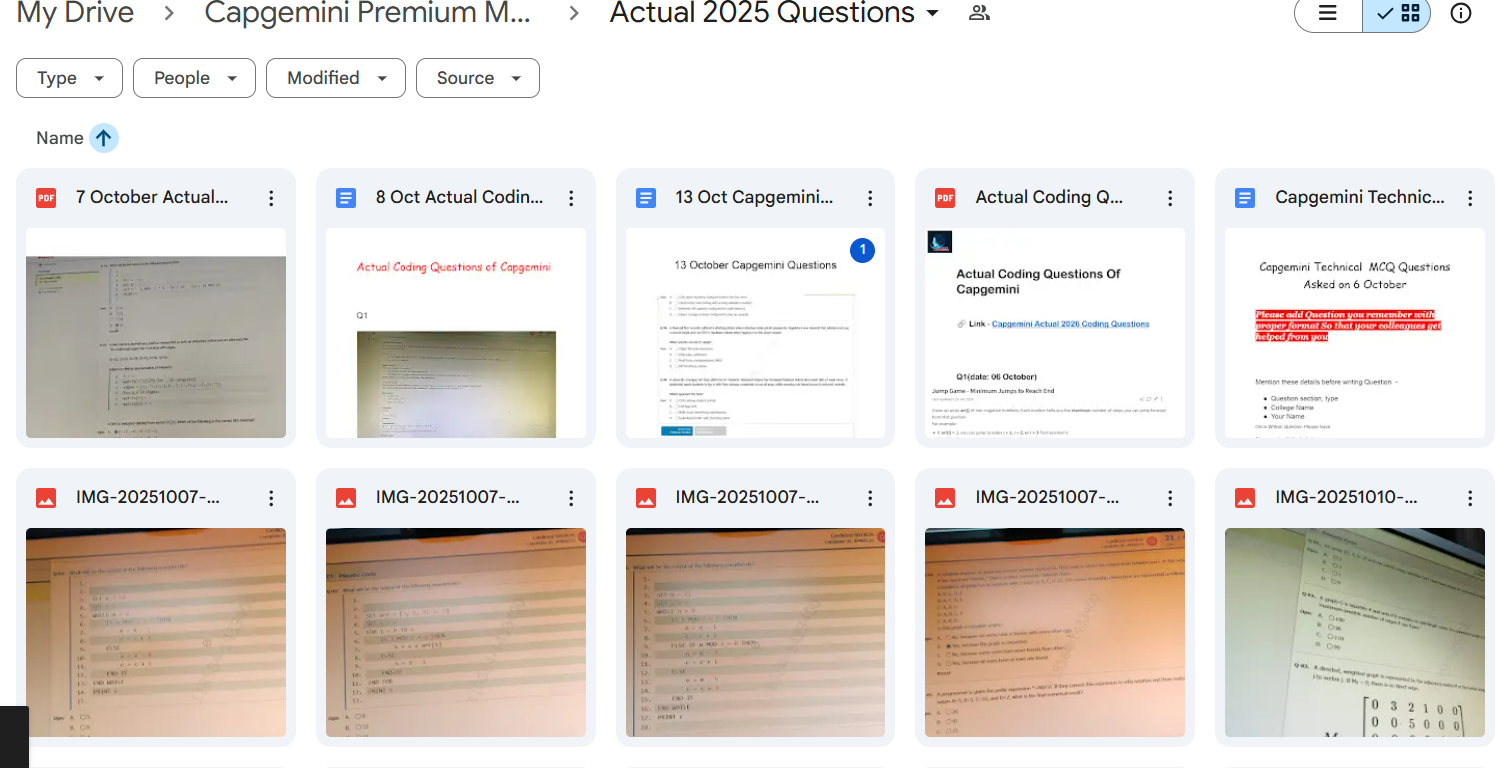
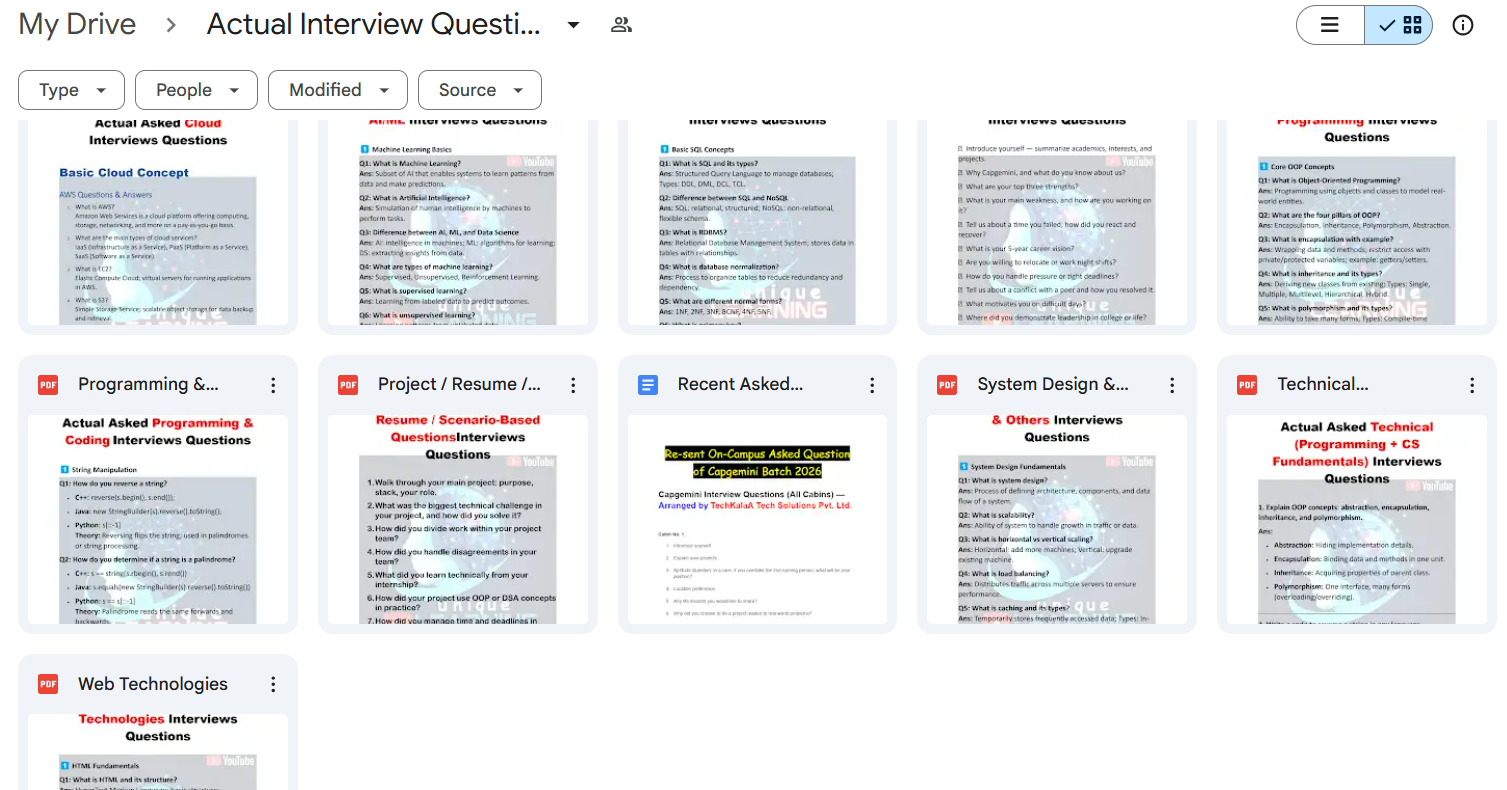
Click a preview to view it larger. Use the controls to browse or pause the carousel.

Capgemini Preparation Materials

See exactly what is included before you buy

The Capgemini materials page lists preparation packs with actual-question practice, core assessment topics, and interview preparation. Open it to review the full package details and place an order.

Package details and pricing below are taken from TechKalaA's Capgemini materials page. Review that page before purchasing.
View Capgemini Materials Review & Buy a Pack
₹259
₹199
  • Complete Exceller preparation and interview pack
  • 1,200+ practice questions
  • 30+ PDFs covering game-based, technical and coding topics
  • 2026 actual asked questions listed in the package
View & Buy Materials
FAQ

Frequently asked questions

No. Capgemini hasn't officially published the 2027 pattern yet. This guide is based on candidate-reported material and placement-prep research, clearly separated from confirmed facts. Always verify with your placement cell.
No — reported material describes the 5 online-assessment stages as sequential elimination rounds. Stages 2-5 are typically attempted together in one sitting once English Communication is cleared.
You don't need prior experience with a specific tool — the round tests how well you structure prompts, guide the AI step by step, and review/correct its output. We cover this in our practice sets.
Reported material lists C, C++, and Java as the supported languages for the single debugging question.
Not confirmed. 2026 reportedly used a tiered structure (roughly ₹4.25L / ₹5.75L / ₹7.5L based on coding performance). No official 2027 figures exist yet — treat any specific number you see as unverified.
It's the opposite of cheating — it's explicitly part of the test. You're graded on your prompting skill, problem-solving approach, and how well you review and correct the AI's output, not just the final code.
Open the Capgemini materials section to view the available preparation packs and current pricing.

Ready to start preparing?

2000+ students trust TechKalaA for placement prep — let's get your Capgemini Exceller 2027 prep on track.